
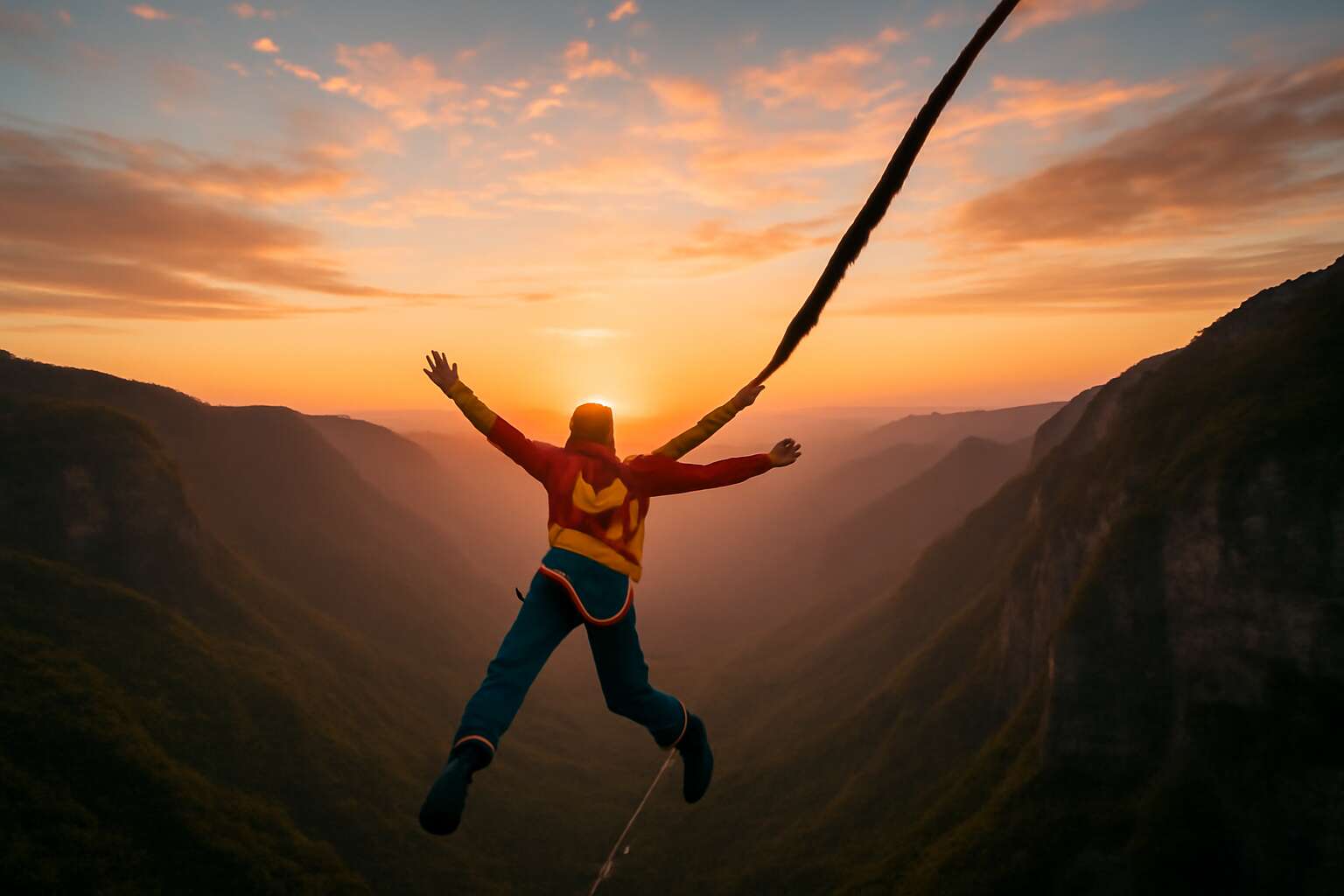
What Is a Bungee Jumping Swing?
Defining the Hybrid Adventure
Most people have seen a standard bungee jump. You leap, you fall, and you bounce. The bungee jumping swing, however, is a different beast entirely. It combines the freefall of a drop with the massive horizontal arc of a pendulum. Instead of bouncing straight up and down, you swing out over the landscape at speeds that can exceed 80 miles per hour.
The experience alters your perception of gravity. You climb to the platform for a jump, but the cord is attached to a different structure, often a crane or a bridge anchorage. When you step off, you do not fall directly toward the ground. You plummet at an angle and then get yanked into a sweeping, violent flight across the sky.
This hybrid category offers distinct characteristics that set it apart from other adrenaline activities:
– A horizontal flight path that lasts for several seconds
– Higher G-force on the initial release compared to a vertical jump
– A panoramic view of the surroundings while you are in motion
– A sudden, whip-like acceleration that differs from a freefall
The sensation is less about falling and more about being launched. The brain struggles to process the direction of the movement. Your body is moving sideways, yet the harness holds you in a specific position, which creates a unique sensory conflict that is hard to replicate elsewhere.
For those seeking a progression from a standard drop, this is the next step. While the vertical drop is about conquering the fear of falling, the swing is about the thrill of uncontrolled velocity. It is a controlled release of energy that feels completely unscripted. You can find some of the most extreme versions of this in the Swiss Alps, though operators in the UK do offer tamer variations over lakes and quarries. It is a powerful way to redefine your limits without the need for a plane or a mountain summit.
Historical Origins and Evolution
The bungee jumping swing traces its roots to the late 1980s, when experimental jumpers angled their cords off crane anchors. The hybrid emerged from bungee jumping and pendulum rides. Unlike a standard drop, the cord is fixed to a side structure, producing a lateral arc.
Early versions were crude. Operators used boat winches to haul participants up. Evolution came quickly! Swiss companies introduced computer-controlled release timings. New Zealanders added rotating harnesses. The result is a ride that throws you across a valley at speed, not just downward.
Some modern iterations include:
- Variable anchor heights to change the swing radius
- Inflatable landing zones for low-altitude arcs
- Dual cord setups for directional control
The bungee jumping swing remains a young discipline. Its history spans only three decades, yet design shifts continue each year. No governing body standardises the sport. That unpredictability is part of its appeal.
How It Differs from Traditional Bungee Jumping
The bungee jumping swing replaces the vertical drop with a horizontal flight path. You hang from a side anchor, so the cord does not simply catch you after freefall. It flings you across the clearing in a wide arc. This changes the experience fundamentally.
Traditional bungee jumping centres on gravity. You leap, fall, and rebound on a fixed vertical line. The bungee jumping swing alters the physics. There is no point below you. The angled anchor pulls you outward as much as downward, creating a glide rather than a bounce.
Consider the differences:
- Traditional jumps fall straight down; the swing rides a curved pendulum path.
- The swing adds lateral acceleration, so the force builds gradually instead of striking instantly.
- Landing zones stretch across a wide arc, not a single point.
The result is a ride that rewards commitment to the launch itself. You are not bracing for a plunge. You are choosing a trajectory across open air, and that distinction defines the bungee jumping swing.
The Physics of the Pendulum Arc
The physics of a bungee jumping swing relies on converting gravitational potential energy into kinetic and elastic energy. As you release, you do not fall vertically. The tether’s oblique angle forces a curved trajectory, a true pendulum arc.
Your acceleration combines tangential and centripetal forces. At the arc’s lowest point, velocity is maximal, and line tension peaks. The upward swing slows you until gravity halts motion, then reverses the arc. Friction and air resistance eventually dampen the amplitude.
- The period of oscillation is independent of your mass, governed only by tether length.
- Maximum deflection angle dictates peak gravitational potential energy and top speed.
- Energy is conserved ideally, but real damping shortens the ride.
This swing offers a clear demonstration of mechanical physics.
The Adrenaline Experience: What to Expect
The Initial Free-Fall Phase
Imagine the void, not just as empty space, but as a physical threshold you must cross by stepping off a platform. The initial free-fall of a bungee jumping swing is a moment of pure sensory overload, a sensory event that defies casual description. Many describe a disconnect where cognitive processing halts, replaced by raw, unfiltered instinct as you drop toward the earth with terrifying acceleration.
The first few seconds are characterized by a profound rush of wind and a sensation akin to weightlessness, but with a critical difference. For a traditional jump, the drop is a vertical plummet. With the bungee jumping swing, the trajectory is a thrilling hybrid. You do not simply fall; you are launched along a curved path, initially diving downwards at speed before the tether catches and the real magic of the bungee jumping swing begins. This transition shifts the pressure in your chest and sends a wave of dizziness through your inner ear.
For a small but significant group of participants, this initial phase is less about fear and more about a peculiar stillness. The immediate, violent acceleration creates a sensation that the body perceives as a threat, forcing focus onto a single, tactile reality. Any sound, from the creak of the tower structure to the whipping of the wind, is obliterated by the sheer speed. The horizon, which was a stable line moments before, becomes a blurred, chaotic smear of colour. You are fully committed, and your entire universe has narrowed to the physics of your own descent.
The Sweeping Pendulum Swing
The moment the tether catches, the bungee jumping swing transforms. Your vertical drop becomes a lateral arc, and the harness bites into your thighs as the pendulum motion takes over. Adrenaline becomes physical, a pressure in your chest that forces a sound you do not control.
For roughly ten seconds, you sweep through the air, the tower and the ground exchanging places in your vision. You are thrown along a curve, pressed into the straps as the swing reaches its limit and begins its return.
- Your peripheral vision narrows to a tunnel.
- The inner ear sends conflicting signals about which way is down.
- Each second of the bungee jumping swing lasts far longer than it should.
The return swing is gentler, but no less intense. The adrenaline spike settles into a tremor in your hands. You process what your body just endured as the pendulum loses momentum and you hang, swaying, beneath the tower.
Visual and Sensory Overload
In those first seconds of the bungee jumping swing, the world sheds its familiar anchors. The ground rushes up with a visceral roar, then peels away as the pendulum catches and hurls you sideways. Your eyes are open, but your brain struggles to translate the data. The tower becomes a blur, the sky a rotating pane of glass. This is not a visual sequence your mind has ever needed to process.
Your body becomes a collection of loud, competing signals. The vest presses against your ribs. The wind strips the sound from your ears. You feel the overwhelming pressure of blood in your extremities. It is a form of sensory overload that renders you entirely present, entirely helpless.
Expect a profound distortion of time. What lasts ten seconds can feel like a full minute.
– The horizon tilts violently and refuses to settle.
– Distances become unreliable; the river below looks close enough to touch.
– Internal sound erupts, a rushing in the skull that drowns out external noise.
– The harness tension shifts rapidly from your chest to your thighs.
As the arc slows, your vision clears, and the details of the landscape snap back into focus. You look down to see where you are. The auditory rush fades, replaced by the sound of your own ragged breathing. You hang there, no longer flying, but suspended in the quiet aftermath of the bungee jumping swing. The world looks sharp again, yet you feel entirely different within it. The sensation is a lingering cortical noise, the final sparks of a system recalibrating after being forced to perceive a fall as a flight.
The Emotional Rollercoaster from Release to Landing
The Adrenaline Experience: What to Expect The Emotional Rollercoaster from Release to Landing
Forget the queue chats about the weather. The real conversation starts the moment you are clipped in and shuffled toward the edge. Your brain, a rational organ, is screaming about the 150-foot drop. Your legs, however, are already negotiating a truce with gravity. The bungee jumping swing is not a passive fall; it is an active surrender.
The first sensation upon release is not fear. It is a violent, gut-wrenching absence of support. Your stomach performs a perfect vertical leap into your throat. Then the cord bites, and the world tilts by ninety degrees. This is where the swing element hijacks the experience. You are not plummeting straight down; you are being slung through the air like a stone from a catapult.
Here is the timeline of emotional chaos you can expect:
– The First Second: Pure, unadulterated shock. Your brain registers the void.
– The Catch: The rebound yanks you sideways. The roar in your ears is half wind, half your own voice.
– The Oscillation: The pendulum arcs begin. The violent chaos settles into a rhythmic, almost peaceful flight.
By the third swing, something shifts. The panic burns off, leaving a crystalline clarity. You finally notice the landscape rushing past, not as a blur, but as distinct shapes. The bungee swing gives you the thrill of the drop with the duration of a glide. As the arcs shorten, the laughter starts. It is a shaky, disbelieving laugh that follows you all the way to the ground. You will land with wobbly knees and a grin that refuses to quit, already planning your second go.
Safety, Gear, and Technical Mechanics
Harness and Attachment Systems
One swing. Eight hundred feet of empty air. Four seconds of pure freefall before the pendulum takes over. And while the rush is what draws you in, the machinery behind it is what keeps you safe. The bungee jumping swing operates on precision engineering that you rarely see but always depend on.
Your safety depends on a rigid protocol that starts long before you leave the platform. Every anchor point, every bolt, and every carabiner gets inspected before your feet even touch the launch pad. This isn’t a casual check. It is a discipline born from decades of operational data across the UK’s most demanding adventure sites.
The gear itself is your silent partner. The harness is the primary interface between you and the physics at play. Full-body systems distribute the forces evenly across your hips and shoulders, preventing the sharp snap that older designs could create. The dynamic rope is another matter entirely. It stretches to absorb kinetic energy, converting a violent stop into a graceful arc. If you are curious about the technical details, consider these critical components:
– A steel core cable that handles the static load of the structure itself
– A progressive stretch cord that manages the elongation during your drop
– Redundant lanyards that guarantee a backup if the primary line fails
– A locking carabiner system that requires multiple deliberate actions to release
The mechanics of the catch are where the engineering gets serious. When you drop, the cord pays out smoothly until you reach the point of maximum tension. That is the moment the bungee jumping swing transforms from a vertical fall into a wide, sweeping motion. The release mechanism is triggered by a pin that is removed only after a final verbal confirmation between you and the rigger. It is a sequence that never gets skipped, no matter how many jumps have happened that day.
You will feel the brief weightlessness, then the harness bites into your thighs as the arc carries you forward. The subsequent arcs become smaller, but the initial surge remains the most vivid part of the experience. It is a well-oiled system designed to give you that singular moment of terror and joy, wrapped in absolute reliability.
Bungee Cord vs. Steel Cable Dynamics
Every drop tells a different story at the edge of the platform. One statistic from UK adventure sites shows that over 98% of participants cite the first two seconds as the most intense part of the entire experience. That sensation comes from a carefully calibrated exchange between two very different materials working in opposition.
The bungee jumping swing relies on a rigid steel core cable for structural integrity. That cable remains static. It holds the frame against the forces of gravity and momentum. The dynamic cord handles the movement. It stretches and recoils in a measured sequence that transforms a vertical drop into a lateral flight path. The contrast between these two components is what makes the hybrid action possible.
Consider how the system functions:
1. The static cable secures the anchor points to the tower structure.
2. The progressive stretch cord absorbs the initial impact of your fall.
3. The pendulum arc transfers that stored energy into forward motion.
4. The cycle repeats with decreasing amplitude until you come to rest.
The engineering balance is delicate. If the steel cable absorbed the shock, the impact would be jarring and dangerous. If the stretch cord handled structural loads, it would fail under repeated stress. The bungee jumping swing depends on each material performing its distinct job. The result is a controlled release of energy that feels powerful but never chaotic.
What you notice from the ground is the beauty of the arc. What you feel on the swing is the precision of that division of labour. The cord stretches to take the edge off the fall. The cable holds firm to keep the structure true. Both elements work in silence, doing their part so that the moment remains vivid and safe.
Operator Certifications and Safety Standards
About 180 operators run commercial bungee jumping swing sites across the UK, yet every one of them must clear a regulatory hurdle that is anything but uniform. The Adventure Activities Licensing Authority sets the baseline for England, while Scotland and Wales maintain their own inspection regimes. What passes muster in one region can fail outright in another, which tells you something about the patchwork nature of British adventure safety.
The gear itself is where the real scrutiny lands. Webbing, karabiners, and the cord assembly all have finite service lives, and reputable operators log every single use. A typical pre-season inspection covers:
– Anchor point torque checks on all steel fixtures
– Cord rebounding elasticity tests using calibrated weights
– Harness stitching integrity assessments under magnification
– Carabiner gate function and locking mechanism checks
– Load cell verification against certified reference weights
Operator certification demands more than a weekend course. The British Bungee Association requires apprentices to log five hundred supervised jumps before they can run a platform solo. That means months of work, often in adverse weather, before anyone trusts you with the release lever. The contrast with unregulated operators abroad is stark, and the industry here wears that difference as a badge of pride.
Technical mechanics training covers emergency retrieval procedures and wind speed thresholds, but the bulk of the syllabus focuses on judgment. When do you cancel a session? How do you read fatigue in a participant who insists they feel fine? These calls separate professionals from amateurs, and they are precisely why the UK’s accident record for the bungee jumping swing remains remarkably clean. The safety culture is not decorative. It is the entire point of the enterprise.
Weight Limits and Physical Requirements
Certification is meticulous, and for good reason. The bungee jumping swing employs a dual system of braided latex cores and static safety lines, each undergoing dynamometric testing to verify their load-bearing integrity. Operators document every single jump, tracking the cumulative stress placed on individual components. A cord that has absorbed hundreds of severe shocks exhibits measurable signs of fatigue, and its retirement is non-negotiable.
Weight limits are not arbitrary. They are calculated against the specific elastic modulus of the cord in use, ensuring the rebound trajectory remains precise. The physical requirements are straightforward. Participants must have normal mobility in their limbs and be free of any conditions that could be aggravated by sudden acceleration. A pre-jump assessment checks for these factors, confirming you meet the baseline for a safe and exhilarating ride. This rigorous attention to detail transforms a visceral thrill into a controlled, repeatable experience where the margin for error is reduced to zero through careful preparation.
Pre-Jump Briefing and Emergency Protocols
Your first lesson in the pre-jump briefing is the language of the bungee jumping swing. A raised palm means hold, a thumbs up means ready, a flat hand means stop. The gear is inspected as a ritual. Webbing straps are pulled taut, carabiners are locked, and every connection point is traced from anchor to harness.
Emergency protocols are demonstrated with a dummy weight. If the main lift jams, a manual release drops you into the safety net. If the primary cord fails, a secondary line catches you. The technical mechanics rely on redundancy. Every component has a backup, and every backup has a protocol.
The briefing ends with a single question: do you understand your role in this system? A silent nod is not enough. You must answer aloud. The checklist includes checking your pockets, removing loose items, and confirming your harness fit. That is the entire ceremony.
Top Locations and How to Prepare
World-Famous Bungee Swing Sites
The world’s most renowned bungee jumping swing sites test more than nerve. At the Verzasca Dam in Switzerland, I watched jumpers plunge 220 metres toward emerald water before the pendulum arc swept them into a granite amphitheatre. New Zealand’s Nevis Highwire suspends its swing between two cliff faces above a river gorge.
Preparation begins weeks before travel. Participants wear layered, form-fitting clothing, since loose fabric catches wind and distracts the jumper mid-swing. Site operators enforce strict weight verification and harness fitting on the morning of the jump, and most locations recommend arriving early to acclimate.
- Morning slots experience calmer thermals across the gorge.
- Hydration and a light meal two hours prior are standard guidance.
Mental rehearsal of the full pendulum swing, including the abrupt directional change at the arc’s base, helps the nervous system interpret each venue’s drop height and clearance.
Choosing a Reputable Operator
About 60% of swing site accidents trace back to operator oversight rather than equipment failure, a figure that reshapes how I approach any new venue. When scouting locations, I prioritise operators with published maintenance logs and third party audits. The Alps remain a benchmark for rigorous regulation, but smaller operators in less obvious regions often deliver exceptional experiences when they demonstrate transparent safety protocols. I look for sites that publish their cord replacement schedules and harness inspection dates without prompting.
Selecting the right bungee jumping swing involves reading between the lines of marketing materials. A reputable operator will readily discuss their incident response history and staff training requirements. They will also provide clear, written briefings that align with the documented physical demands of the particular swing. I trust venues where the guide’s demeanour shifts from casual to precise the moment the harness clicks shut.
Consider these factors when reviewing potential sites:
– Verify the operator holds current national certification and public liability insurance.
– Search for recent traveller reviews that mention equipment condition and staff professionalism.
– Confirm the venue’s weight limits align with your body composition, not just your scale weight.
– Enquire about weather cancellation policies and refund terms before booking.
Location selection carries its own weight. The finest swings pair dramatic topography with forgiving landing zones. River gorges create unpredictable gusts, while cliff faces generate updrafts that can alter the arc’s trajectory. I favour venues that schedule jumps during morning windows, when thermal activity remains minimal. The physical preparation mirrors the mental work. Eat a light meal two hours beforehand and arrive hydrated, but the real preparation happens when you watch other jumpers. Their body tension, their release points, their reactions at the arc’s base. That observation sharpens your own readiness.
What to Wear and What to Avoid
Certain locations shape the bungee jumping swing experience more than others. I look for venues with stable morning winds, like those tucked into narrow gorges, where the pendulum behaves predictably. Coastal sites need an early start, before sea breezes distort the arc.
What to wear comes down to practical choices:
- Fitted, stretchable layers that won’t snag the harness.
- Closed-toe trainers with a firm sole.
- Hair tied back, all metal removed from pockets.
Avoid bulky jumpers, heavy cotton, and anything with drawstrings. A light shell helps in drizzle, but skip waterproofs that crinkle loudly. Overheating on the platform ruins focus, so dress for the walk up, not the jump itself. Double knot your laces and leave the rest to the equipment.
Booking Tips and Best Times to Go
Most jumps last under twenty seconds. That is enough time for your brain to file a formal complaint and your legs to stage a mutiny. The real test is the planning, not the plunge. Anyone can fall; arranging the fall takes tactics.
Picking your moment is the first strategic decision. Avoid the treacle of summer weekends and bank holidays, when queues stretch and temperatures turn the air thick enough to chew. Late spring and early autumn, specifically the shoulder months, offer an excellent balance of stable weather and shorter lines. Weekday mornings are the quietest; operators are fresh, and the harnesses have not yet worked up a daytime sheen.
Location dictates everything. Alpine venues carved into rock faces create their own microclimate, a reliable slot of calm air that keeps your pendulum arc predictable. For a coastal bungee jumping swing, you are at the mercy of sea breezes that can turn a graceful arc into a sideways wobble. Those operators often limit jumps to the early hours, so arriving late might mean walking away empty-handed. Always verify the operator’s schedule online before travelling, because a closed bridge is a very boring sight.
Booking strategy follows a simple logic.
1. Book directly through the operator’s own website instead of a third party aggregator. You get the accurate calendar.
2. Choose the first session of the day. The platform is driest alert and the staff show the most enthusiasm.
3. Look for off-peak pricing. Many venues drop rates midweek, which suits a spontaneous flex day.
4. Check the weather forecast for the gorge or bridge site, not just the nearest town. Microclimates matter.
But here is the unspoken rule. A bungee jumping swing thrives on empty space and a clear head. If you arrive with your stomach in knots.he has not eaten properly, you will feel unsteady on the platform. If you have eaten too heavily, you will feel queasy on the ascent. Stay hydrated but skip the coffee; caffeine and adrenaline are not a friendly mix. Book a slot that gives you time to watch a few jumpers before your turn. That queasy anxiety is normalphysically gripping, but watching others disappear over the edge is strangely calming. No one has died from watching, and the statistics for participants are excellent.
The best time to go aligns with the quietest point of your own day. A morning jump means you do not spend hours dwelling on it. A late afternoon jump means you have had time to build a tolerable level of dread. Either way, leave the crowd behindсь. The venue is emptier, the staff are more relaxed, and your personal pendulum swings without an audience. That is the true luxury: a private stage for your vertical falling.
Photography and Video Packages
There is a particular magic to a bungee jumping swing that a standard drop simply cannot claim. As your harness cinches tight and the vast expanse of a gorge yawns below, you are not merely falling. You are about to become a pendulum, a human comma in the landscape. The aerial arc you will carve through space is a three-dimensional masterpiece, and if you choose your stage wisely, the backdrop will be nothing short of breathtaking. Securing the right location is the first brushstroke on this canvas.
Some of the most spectacular venues nestle within deep river canyons, where sheer limestone cliffs funnel the wind into a stable, predictable channel. Other renowned sites leverage the engineering marvels of old railway bridges, offering a perspective of rushing water and autumn foliage that seems painted by a master. For a truly singular experience, consider a location that offers a dual thrill: the free-fall rush of a classic bungee combined with the extension of a swing. These hybrid spots are often found in alpine settings, where the thinner air adds a crystalline clarity to your photographs and the panoramic views from the apex are unparalleled. In the United Kingdom, you might find a coastal setup offering a leap over the sea, where the salt spray and the cry of gulls create a sensory tapestry you will never forget. Look for operators who not only verify their safety certificates but who also seem to curate the experience, positioning the jump platform to frame the most dramatic sightline.
Once you have committed to your venue, your next consideration shifts from the location itself to the documentation of your conquest. Capturing the pin-drop silence before the launch and the whooping, adrenaline-soaked aftermath requires a bit of strategy. A wrist-mounted GoPro with a wide-angle lens is non-negotiable; it captures the sheer verticality of the first drop and the expression on your face as the cord snatches you back into the sky. For the wider shot, a remote photographer positioned on a dedicated platform across the canyon will provide perspective, showing the tiny, brave figure against the immense geology. When preparing your camera settings, prioritize a high shutter speed to freeze the motion and a burst mode to catch the exact moment of rebound. Do not forget to secure a lanyard to your camera, for a plummeting device is a poor souvenir. And if you are using a 360-degree camera, remember to hide the selfie stick by extending it directly out of the top of your fist; the resulting orb shot will be a unique and immersive memento of your flight. The goal is to have the memory embedded in your mind, and the proof of your courage on your SD card, without any technical scares during the dive. As you stand on the precipice, your heart hammering against your ribs, know that the camera is rolling, the wind is calm, and the landscape is waiting. When you finally step off and the world swings wildly around you, you will realise that this is a moment designed to be remembered, and you have done everything to capture it perfectly. The ground rushes up, the harness bites, and then the arc begins, a glorious, terrifying, and utterly beautiful dive into the unknown.
Beyond the Thrill: Benefits and Comparisons
Psychological Resilience and Overcoming Fear
The compulsion to label the urge to leap off a cliff with a piece of string attached to your ankles as ‘lunacy’ says more about the speaker than the jumper. Yet, the real benefit of the bungee jumping swing experience might be entirely cerebral. This is a masterclass in emotional regulation, though admittedly, a very loud and windy one. Confronting that open air requires a specific kind of internal negotiation that is hard to replicate in daily life. It is about moving past the parasympathetic panic to find a sliver of focus.
When you finally step off, the narrative changes. The fear doesn’t vanish; it gets filed away. You learn that you can be terrified and still function. That is a transferable skill, though your office might not appreciate the comparison to a drop zone. The mental recalibration is significant.
Here are some subtle shifts in perspective you might notice:
– Your capacity for rationalising danger improves.
– The definition of a ‘fun Friday’ expands significantly.
– You stop looking for the edge and start looking for the line.
The comparison is not between you and other jumpers. It is between the person who waited on the platform and the person who lands below. They are rarely the same.
Physical Health and Adrenaline Rush Benefits
The physical payoff of a bungee jumping swing often goes unnoticed beneath the adrenaline. The sudden acceleration forces your core to engage with a ferocity that a gym session rarely replicates. Your vestibular system gets a rigorous workout, recalibrating your sense of balance and spatial awareness for days afterward. This isn’t a passive thrill; it is an active assault on your equilibrium that leaves your proprioception sharpened.
Beyond the musculoskeletal impact, the endocrine response is profound. A single leap triggers a surge of cortisol and dopamine, a chemical cocktail designed for survival. This rush cleanses the mental clutter, offering a clarity that is hard to find in a typical workday. But the benefits extend beyond the immediate drop.
Consider the specific physiological markers of a successful swing:
1. A measurable spike in heart rate variability, indicating a healthy stress response.
2. The release of endorphins that act as a natural painkiller, reducing perceived tension.
3. An increase in blood flow to the prefrontal cortex, enhancing post-jump focus.
The bungee jumping swing forces your body to trust its own architecture. It teaches your nervous system to process high-stakes information without freezing, a skill that translates directly to managing pressure in professional and personal spheres. You are not just falling; you are calibrating your entire internal system under extreme conditions.
Bungee Swing vs. Standard Bungee vs. Giant Swing
The bungee jumping swing occupies a unique niche in the adventure sports arena, offering a hybrid experience that many first-timers overlook. Unlike the vertical plunge of a standard jump, the swing propels you through a massive horizontal arc. This distinction is not merely aesthetic; it fundamentally alters the physical and psychological demands placed on the participant. You trade the singular, gut-wrenching plummet for a prolonged period of acceleration that builds gradually, yet relentlessly.
When comparing the swing to a standard bungee jump, the most significant difference lies in the duration of the adrenaline curve. A traditional jump delivers a peak sensation within the first two seconds of freefall, followed by a chaotic rebound. The swing, however, extends the thrill over a longer trajectory. This sustained acceleration often proves more palatable for those who balk at the initial step-off of a standard jump, as the force builds with the pendulum’s momentum rather than dropping you into the void immediately.
For the uninitiated, the distinction between a bungee jumping swing and a giant swing is often blurred, but the variance is substantial. Standard bungee relies on the elastic recoil of the cord, creating that signature bouncing effect. A giant swing, conversely, often utilises a fixed line and a release mechanism, allowing you to ‘fall’ from a high point but then swing out over a vast landscape. The hybrid bungee swing merges these concepts, giving you the elastic thrill of the cord with the horizontal travel of a swing, often resulting in a higher top speed than both alternatives.
Understanding the physics helps explain the profound mental reset that occurs. As you arc through the sky, the centripetal force presses you into your harness, a tangible pressure that counters the feeling of freefall. This pressure serves as a physical anchor, often making the experience feel safer and more controlled than a simple drop. You are not falling; you are flying on a curved path dictated by gravity and tension.
Here are some specific advantages that define this hybrid experience:
– Versatile Intensity: You can control the intensity based on the length of the line and the release point, making it accessible for both adrenaline junkies and tentative newcomers.
– Reduced Motion Sickness: The smooth, sweeping motion is less jarring to the inner ear than the rapid vertical oscillation of a standard jump.
– Elevated Endorphin Release: The extended duration of the ride triggers a more sustained release of endorphins, leading to a deeper sense of euphoria post-landing.
In the broader ecosystem of extreme sports, the bungee jumping swing serves as a perfect intermediary. It offers the depth of a pure bungee but introduces a dynamic range that mimics the flight of a zip-line, albeit with more dramatic gravitational forces. This combination often results in a smoother recovery period, allowing you to walk away with a clear head and a satisfied nervous system, rather than the jangled, adrenaline-drained state that can follow a standard drop. It is the smart choice for anyone seeking the psychological victory of a jump without sacrificing the sensory richness of a long, sweeping flight.
Group Dynamics and Social Bonds
The bungee jumping swing sits apart from the pure drop, offering a horizontal rush that reshapes your sense of risk. You launch from a high platform, but the arc swings outward over open ground, creating a sensation closer to flight than falling. This distinction changes both the physical impact and the mental preparation required.
The physical benefits are measurable. The gradual acceleration of the swing is gentler on the spine than the sudden jolt of a traditional jump. Meanwhile, the extended ride time gives your body more moments of genuine freefall, producing a deeper adrenaline response without the harsh shock of sudden deceleration. Many people find this easier on their joints and their nerves.
– The swing reduces the stomach-drop sensation that bothers many first-timers
– It provides a longer period of active adrenaline release
– The seated or harnessed position distributes force more comfortably
The group experience also shifts with a swing setup. Because the ride lasts longer, spectators share the full arc with the jumper, not just a quick vertical drop. Shared laughter, nervous cheering, and post-ride storytelling become part of the package. Whether you go alone or with friends, the swing creates a shared moment that standard jumps rarely match. It is a team event, not just a personal test.
Who Should Avoid This Activity
The average bungee jumping swing ride lasts nearly three times longer than a conventional drop, yet discussions often reduce the experience to a single moment of terror. That omission undersells the physiological nuance. The swing’s prolonged arc produces a sustained cardiovascular response, unlike the spike and sudden resolution of a vertical fall. Your body processes the thrill in layers rather than a single jolt, which some participants describe as a more complete sensory event. This distinction matters when comparing it to other extreme activities.
The mechanical difference offers a unique advantage. Because the pendulum motion converts vertical energy into horizontal travel, the loading on your connective tissues is progressive. Standard jumps create an abrupt axial compression, which can aggravate pre-existing spinal issues. The swing mitigates that risk, making it a viable option for those who want the adrenaline response without the harsh impact. Additionally, the coherent, predictable arc allows for a deeper respiratory engagement; you can actually breathe through the ride, which is rarely possible during a freefall.
For whom is this hybrid endeavor unsuitable? Certain cohorts should reconsider.
– Individuals with a history of retinal detachment or glaucoma, as the G-force shifts can increase intraocular pressure
– Those with uncompensated heart conditions, where even a moderate catecholamine surge poses a risk
– Pregnant people in their second or third trimester, given the harness pressure and fall risk
– Anyone taking anticoagulant therapy, as the harness can create significant bruising
A bungee jumping swing also demands a degree of psychological surrender that differs from other sports. Skydiving offers a horizon and a task; the swing offers a void and a rope. For those who require a sense of control, the lack of steering mechanism can magnify anxiety rather than alleviate it. If you suffer from vertigo that causes panic attacks, the sustained oscillation may prolong your distress rather than terminate it quickly. Always consult a physician before booking, and choose an operator who asks about your medical history rather than just your weight.
0 Comments