
Understanding Killiecrankie Bungee Jumping
What is Killiecrankie Bungee Jumping?
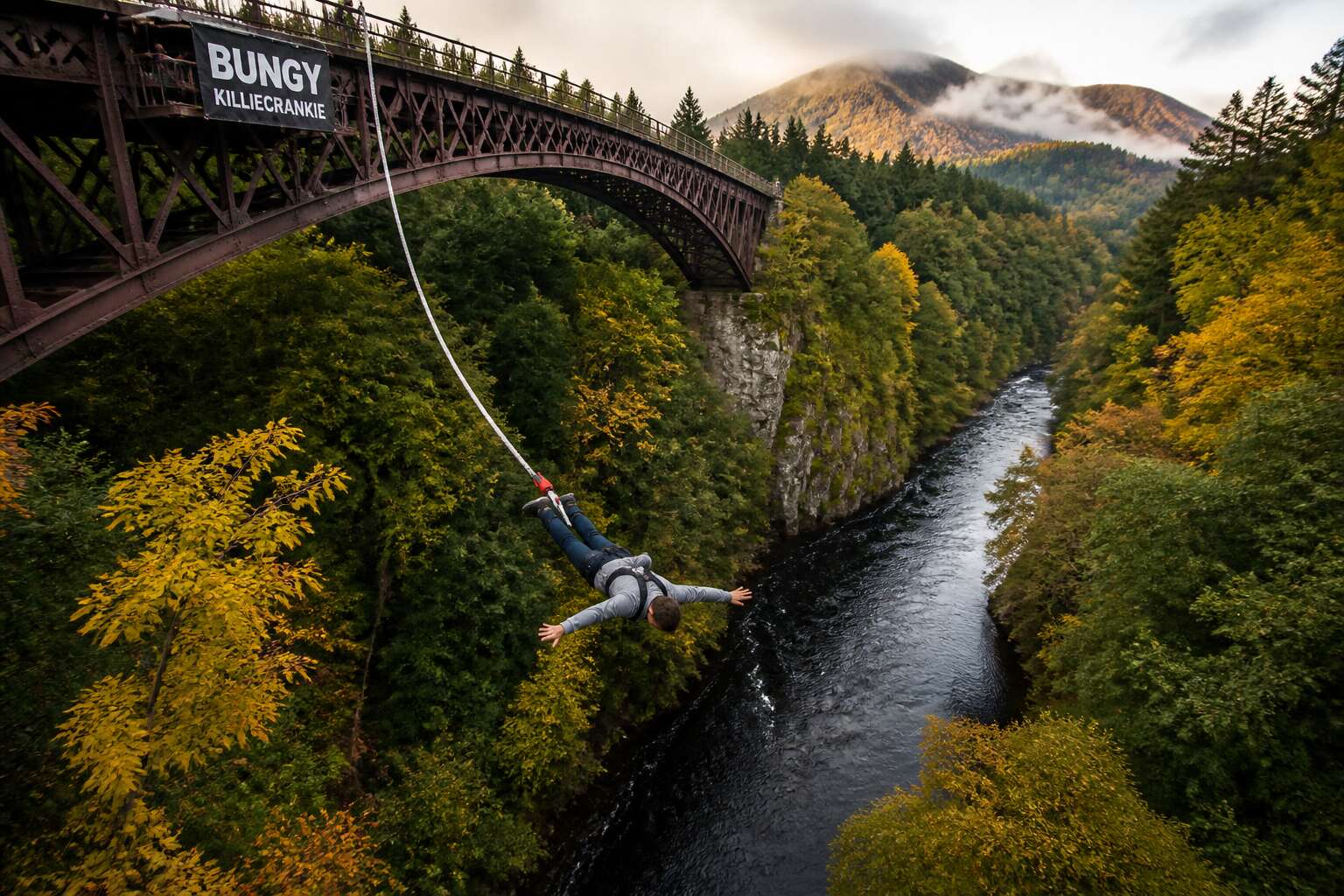
Killiecrankie bungee jumping occurs above the River Garry in Perthshire, within the narrow Killiecrankie Pass. This singular experience involves leaping from a purpose built crane suspended over the gorge, with the jump measured at over 40 metres. To me, the sport’s appeal lies in the weightless seconds after the freefall and the subsequent rebound.
Participants are secured with a full body harness rather than ankle cuffs, a distinction that makes the plunge more comfortable for first timers. The location offers:
- A suspended bridge for final nervous glances
- A controlled descent into the narrow valley
- A professional ground crew with decades of combined experience
Understanding this activity requires recognising that it is a fully regulated operation, set within Scotland’s national landscape, yet accessible to anyone over fourteen.
The History of Bungee Jumping at Killiecrankie
Every jump at Killiecrankie repeats a story that began with a desperate soldier! In 1689, a fleeing survivor of the Battle of Killiecrankie reportedly cleared the chasm above the River Garry in a single terrifying bound. His motive was survival. Mine, when I first stood on that platform, was something closer to curiosity. The same gap that once separated life from death now separates doubt from decision.
The recorded history of killiecrankie bungee jumping is shorter, but no less deliberate. Highland Fling positioned its crane above the gorge in the early 1990s, transforming the legendary leap into a scheduled, regulated event. Three phases define that evolution:
- folklore established the site’s mystique
- engineering made the jump repeatable and safe
- regulation carried it into the present day
Why Choose Killiecrankie for Bungee Jumping?
The Experience: From Ledge to River
At the precipice, time dissolves into a singular, crystalline moment. The roaring River Garry, a ribbon of silver far below, seems to hold its breath alongside you. Your heart hammers a primal rhythm, a drumbeat against the vast silence of the Highland gorge. This is the threshold, and the next step is a conversation between gravity and courage.
The Ground is a Ghost.
Standing on the platform, the solid earth feels like a distant memory. The air here is different, charged with the scent of pine and adrenaline. As you shuffle to the edge, the harness is a reassuring embrace, a delicate web of webbing that is now your only tether to the world you know. A deep breath, a small, deliberate shuffle, and then you are airborne. The sensation is not one of falling, but of being claimed by the sky. The initial freefall is a violent, exhilarating surrender, a complete erasure of thought where pure instinct takes over.
Then comes the rebound and the symphony of the swing. The world whips past in a blur of green and grey. As the cord catches, you are launched back towards heaven, weightless and silent. Here, in the pendulum’s arc, a strange tranquility descends.
The sequence is always the same, yet feels entirely new:
1. The dive, a two-second lifetime of absolute silence.
2. The first bounce, a shockwave of pure joy that cancels all fear.
3. The gentle rocking, a slow dance suspended above the river’s flow.
Finally, you are winched back to the platform, legs trembling and a smile stretched wide across your face. The ground is solid again, but you are not. You have not just jumped; you have soared, and the memory of that weightless peace will cling to you long after your feet have touched the earth.
Key Stats: Height, Drop, and Location
At 40 metres, the Killiecrankie bungee jump offers a drop that is substantial yet accessible. The platform itself is suspended over the River Garry, deep within the Pass of Killiecrankie. This is not a tower or a crane; the jump is anchored to the gorge’s natural architecture, which creates a unique sensation of leaping into the wild itself.
The location does much of the work. The surrounding Perthshire countryside is dense with ancient woodland, and the river below is a constant, rushing presence. The height is significant enough to deliver a genuine freefall, but the environment makes it feel less like a clinical fairground ride and more like a raw encounter with the landscape. You are not just getting a thrill; you are getting a very specific piece of Highland geography.
Here are the essential numbers:
– Height: 40 metres from the platform to the river.
– Location: The National Trust for Scotland’s Killiecrankie Visitor Centre, near Pitlochry.
– Setting: The dramatic Pass of Killiecrankie, a steep wooded gorge.
Preparing for Your Killiecrankie Bungee Jump
How to Book Your Killiecrankie Bungee Jump
Perched above the rushing waters of the River Garry, the bridge at Killiecrankie is a landmark that demands respect before it rewards bravery. Preparation is the quiet partner to adrenaline, and getting ready for a killiecrankie bungee jumping session involves more than just turning up. You will need to consider the weather, as the Highland climate can change rapidly, and you should wear secure, comfortable clothing that allows for a full range of movement.
A short checklist will help you stay focused on the experience rather than the logistics. Remove all loose items from your pockets before you arrive. Wear lace-up shoes that will stay firmly on your feet, and tie back long hair to keep it out of your face. It is also wise to eat a light meal a couple of hours beforehand, keeping your energy steady without feeling heavy. Arriving with a clear head and a prepared body makes the entire process far more enjoyable for everyone involved.
When you decide to book your jump, the process is refreshingly straightforward. Most killiecrankie bungee jumping operators offer online reservations, which allow you to secure a specific time slot well in advance, a crucial step during the bustling summer months. You will need to check the specific weight and age restrictions that are standard for this activity, and you will likely be asked to confirm that you are in good general health upon arrival.
The booking system is efficient, but it does require attention to detail. You should read the terms carefully to understand the cancellation policy, especially given how changeable the Scottish weather can be. Payment is typically taken upfront, and you will receive a confirmation with clear directions to the site. From the moment you book, the anticipation builds, but the preparation ensures that when you are standing on the edge, your only job is to enjoy the leap.
What to Wear and Bring
So you have booked your leap. The date is marked. Now comes the practical matter of what to do in the hours before you throw yourself off a perfectly good bridge. The most crucial piece of the puzzle is your wardrobe. You want to feel comfortable, obviously, but you also want to ensure nothing interferes with the harness or the cameras that will capture your terrified expression. The Highland weather is a fickle beast, so layers are your best friend here. A light, breathable base layer with a fleece or hoodie on top will allow you to adjust if the sun decides to make an appearance or a chill wind whips up from the gorge below.
You will be tempted to wear your favourite trainers, but consider the grip. The platform can be slick with morning dew or recent rain. You will want footwear that stays firmly on your feet; a pair of sturdy lace-ups is ideal. Avoid anything with deep treads that could catch on the platform edge. For the ladies, leave the heels at home, this is not a fashion show, it is a test of nerve. Jewellery should be left behind too; necklaces and dangling earrings are just hazards waiting to happen. For those with long locks, tie your hair back securely. There is nothing worse than a face full of hair when you are trying to enjoy the rush of freefall.
Beyond the clothing, you need to think about the sensation itself. The moment the instructor attaches your harness, you will feel a shift in your stomach. To manage this, eat a light meal about two hours before your slot. Something simple like toast or a banana will give you energy without weighing you down. Hydration is key, but skip the fizzy drinks. Now, as for what to bring with you, the rule is simple: minimalism. Leave your phone, keys, and wallet in the car or a locker. If you have a GoPro, check with the team first, as they have their own filming packages that will capture the entire descent. This ensures your hands are free to grip the rail, your head is clear, and your focus is solely on the breathtaking view of the River Garry waiting below. This preparation is part of the ritual, and it guarantees that when you are stood on the edge, your only thought is the jump itself.
Physical and Health Requirements
Every year, thousands of travellers make the pilgrimage to Perthshire, and a significant portion are there for one specific adrenaline pursuit. There is a physical baseline for this activity, and it is not about being an elite athlete. You need to be in adequate health to handle the sudden acceleration and the harness pressure against your body.
The operator at Killiecrankie bungee jumping enforces strict weight parameters, typically ranging from 45 kilograms to 120 kilograms. This ensures the equipment functions exactly as engineered. If you are on the periphery of this scale, you should contact the team before your booking to confirm your eligibility. Claustrophobia is rarely an issue, but a fear of heights is something you will confront directly as you shuffle to the edge.
Certain medical conditions require a frank conversation with your doctor before you travel. These are the bucket-list killers:
1. Any history of epilepsy or blackouts.
2. Back or neck problems, including previous fractures or herniated discs.
3. High blood pressure or previous heart issues.
4. Pregnancy.
5. Recent surgery involving stitches or muscle tears.
The Highland Fling is not a static drop, it is an arc. This means the velocity is high, and the strain on your lower back and shoulders is immediate. You will feel a hard tug as the cord stretches to its limit. If you have a weak ankle or a trick knee, the landing procedure involves being winched down to a soft mat, so impact is minimalpreads. However, the harness sits snugly around your thighs and waist, so abdominal sensitivity is a factor.
You do not need to be flexible, strong, or particularly fit for killiecrankie bungee jumping. You do need to be honest about your medical history. The safety briefing will cover the brace position, which involves keeping your chin tucked and your arms on the rail. The brief walk to the jump platform is calm, but your heart rate will spike. That is a normal physiological response to a perceived threat.
The entire process, from harness fitting to the winch down, takes about ten minutes. Your body will be flooded with adrenaline, which can mask fatigue. Hydrate well in the hours prior, but avoid heavy meals. The staff will ask you to sign a declaration of fitness. If you are over 40, they may request a note from your GP detailing any pre-existing conditions.
Arriving with a clear head is as vital as a healthy heart. The physical requirements are manageable, but the mental commitment is the true barrier. You must be prepared to follow instructions while standing on a platform that creaks slightly in the wind. If you have any doubt about your physical readiness, err on the side of caution and consult a professional. The jump will be waiting for you after recovery.
Understanding the Safety Protocols
Preparation for killiecrankie bungee jumping begins in the quiet moments before you leave your car. The safety protocols are not complicated, but they are absolute. Listen to the briefing with the same attention you would give a pilot before takeoff. The staff will show you the brace position, explain the winch retrieval, and answer every question you have.
Arrive early. Thirty minutes gives you time to settle your nerves, complete the harness fitting, and review the fitness declaration for killiecrankie bungee jumping. The crew has guided thousands of first timers through this exact process. Their calm is contagious.
When you shuffle toward the edge, three rules anchor the moment:
- Chin tucked, arms on the rail.
- No hesitation once the countdown begins.
- Trust the equipment, the crew, and your own resolve.
Follow these protocols, and the jump becomes what it should be: a controlled, exhilarating release.
What to Expect on the Day
Some say the bravest moment of killiecrankie bungee jumping is not the fall, but the ten seconds of silence before the countdown begins. The air grows still. The river below sounds like a distant whisper.
Your heart performs its own drumroll. The bridge feels solid underfoot, and the crew’s hands are steady as they perform the final clip checks. You notice the sky, the way it stretches wide and indifferent. That is a comfort.
Consider the sequence of your approach.
1. Walk to the chalk mark like you own the morning.
2. Place your hands exactly where the guide indicates.
3. Breathe in on three, and let the world fall away.
The preparation is almost meditative. There is no queue behind you, only anticipation. The crew member speaks in a low tone, not a shout. Their calm is a blanket. By the time they say the word, you will have already decided to fly.
The return is a slow, inverted pendulum swing. The harness holds you in a firm, almost paternal grip. You dangle above the water in the hush, and the winch begins its patient work. The day is done, but the tremor in your legs will follow you down the path, a private souvenir that costs nothing.
The Killiecrankie Bungee Jumping Experience Explained
The Ledge and the View
Standing on the ledge, the River Garry narrows below you. The water moves fast, but the sound reaches you late. This is the quietest part of any jump, and it defines killiecrankie bungee jumping.
The view stretches across the Pass of Killiecrankie, where trees crowd the cliffs. On a clear day, you can see the old railway line and the road winding north. To your right, the Soldier’s Leap adds a historical marker. To your left, the gorge opens into wilder terrain.
- The ledge itself is a steel platform with a low rail.
- The jump master checks your harness twice before the countdown.
- Most people spend longer looking than jumping here.
That moment before you lean forward changes your memory of the place. For a few seconds, the ledge holds you still, then the drop takes over.
The Jump Sequence
Killiecrankie bungee jumping rewards a precise rhythm. The moment arrives without ceremony! You cross your arms, your weight shifts forward, and your toes leave the steel platform. The drop is silent at first, then the rope’s tension gathers you into a rebound.
- The initial fall lasts three seconds.
- The rebound lifts you for two seconds.
- The final swing slows into a hang above the water.
Each oscillation shortens. I count the oscillations. The crew’s hands appear, pulling you to the recovery deck. The sequence ends, but the sensation of weightlessness lingers. The rhythm repeats on every jump, down, up, down, until the rope stops swaying.
The Freefall and Rebound
At 46 meters, the Garry Bridge platform offers one of Scotland’s most accessible adrenaline experiences, yet the Killiecrankie bungee jumping scene remains surprisingly intimate. You are not sharing the ledge with a conveyor belt of thrill-seekers; the operation runs on a measured, personal schedule.
The springboard itself is a narrow steel grating. The wind has a direct path through the gorge here, and you feel it against your face before the jump master clips your harness. That moment involves a series of clicks and physical tugs, a system of checks that feels methodical rather than hurried.
When you step off, the initial seconds are a lesson in acoustics. There is no rushing air at first, just the sensation of leaving the structure and a strange silence. The drop is clean, vertical, and you have enough time to register the river water rushing up before the elastic catches. The rebound is a different kind of force, a hard tug under the arms that compresses your spine before you float back down.
For those on the fence about the disorientation, the process is straightforward:
– The jump is a clean swan dive or a backward fall, your choice.
– The rebound is a series of decreasing oscillations, not a violent snap.
– The retrieval involves a winch lowering a hook to your harness, which is a smooth, steady ride up.
It is a far cry from the industrial scale of bridges in the Swiss Alps. The surrounding woodland and the River Garry narrow the perspective, making the descent feel more calculated and less like a free fall into open space. The sheer rock walls rush past at a readable speed, giving your brain a reference point as you bounce.
The experience is efficient. From arrival to the moment you are unhooked on the bridge again, you are looking at about forty-five minutes, most of which is admin and walking to the platform. The actual jump sequence, from the countdown to the final still swing, lasts barely thirty seconds. But the physical memory of the Garry Bridge rebound, that sharp upward yank, tends to linger far longer than the brief time spent in the air. It is a sharp, clean hit of adrenaline with a scenic payoff.
Coming Back Up: The Return System
The landing is the part most people don’t think about. After all the adrenaline, you are dangling upside down with the River Garry rushing below, and the crew has to get you back to solid ground. This is where the “one-and-done” return system comes into play. It is not a complex motorized crane operation like you might see at a permanent amusement park. Instead, the team on the bridge pulls you up manually using a simple pulley system. It is efficient, straightforward, and adds a brilliantly human touch to the entire affair.
Once you give the thumbs up, the crew lowers a weighted line with a metal clip. You attach it to your harness, and the physical work begins for the team above. You do not get hoisted at high speed. The ascent is a slow, steady, and remarkably smooth ride that gives you ample time to look around. You get to see the gorge from a completely different angle. The trees, the rocks, and the water all come back into focus as the world slowly rotates right side up. It is a disorienting but welcome reprieve.
To make the process clear, here is how the retrieval typically unfolds:
1. You signal you are ready to be pulled up.
2. The crew lowers the retrieval line for you to clip onto your harness.
3. The team pulls you up hand-over-hand, maintaining a constant, controlled pace.
4. As you reach the bridge deck, a crew member grabs you and guides your legs back over the railing.
Suddenly, you are standing on the platform again, your legs feeling like they belong to someone else. The entire jump, from the waiting to the return, feels more like a personal challenge than a mass-market attraction. That is the real charm of the place. It is not just about the fall; it is about the complete, communal process of getting you back up, ensuring you are safe, and sharing that brief moment of disbelief with you. You walk away with your heart pounding, but also with a profound respect for the small-team operation that makes this raw experience so accessible.
Capturing Your Jump: Photos and Videos
Your loved ones up on the bridge will have a prime view of the River Garry far below, but capturing you mid-flight is another matter. The wide-angle lens on a phone struggles with the sheer verticality of the jump, and your descent is genuinely hard to track from above. Many spectators end up with footage of an empty sky followed by a distant, distorted figure. It is a well documented phenomenon of killiecrankie bungee jumping that the most dramatic moments are the hardest to frame.
You have two solid options to ensure the evidence is usable.
1. Bring a capable friend with a zoom lens to stand on the bridge approach.
2. Rely on the official photography team who have cameras perched on the gorge wall.
3. Purchase the full video package, which includes multiple angles.
The official service is the more reliable route. Their system of fixed cameras syncs the image of you stepping off the ledge with the slow-motion capture of the freefall and the stretched rebound over the river. The final product is a slick, high-definition edit set to music, which is far superior to a shaky phone recording. You will find the footage is ready for download shortly after you are back on solid ground, making it a fantastic keepsake of the experience.
The poor quality of amateur attempts is a common point of discussion among the crew. They have seen countless shaky vertical videos that completely miss the drop. The operator often advises you to simply wave at the known camera positions at key points, such as just before the leader pulls the ripcord, to guarantee you are in the shot for the high-angle finish. This adds a fun layer to the affair. You get to play the part of the seasoned daredevil, winking at the lens before plummeting downwards. When you later review the official footage, the whole enterprise feels remarkably professional, and your place in the history of your own adventure is securely recorded. Walking away with that memory card in your pocket is the perfect finale to the killiecrankie bungee jumping experience, with your wobbly legs and the shrieking in your eardrums serving as the physical proof.
Practical Information for Visitors
Getting to Killiecrankie
Getting to Killiecrankie is a pilgrimage of sorts, requiring deliberate intention rather than casual spontaneity. The village sits in the Perthshire countryside, roughly a 45 minute drive from Pitlochry. ScotRail trains from Edinburgh and Glasgow stop at Pitlochry station, from which a short taxi completes the journey. Drivers follow the A9 to the Killiecrankie junction, then negotiate the narrow road descending into the gorge.
Killiecrankie bungee jumping draws visitors all year, and the journey itself forms part of the psychological preparation. Arriving by car demands patience during peak months, when the small car park fills early.
- Check the ScotRail timetable before booking your jump
- Confirm parking availability with the operator before travelling
- Allow an extra 30 minutes for unfamiliar rural roads
Bus travel remains workable if less frequent. The 87 service from Pitlochry passes through Killiecrankie village, leaving a ten minute walk along the old military road to the meeting point. Build your travel buffer accordingly.
Nearby Amenities and Accommodation
The quiet after the rebound is where the mind catches up with the body, and the practicalities of the day return with sudden weight. You will need somewhere to wash the adrenaline from your skin. Killiecrankie bungee jumping exists within a landscape that offers few immediate concessions to comfort, so the nearby village of Pitlochry becomes your staging ground.
Within a ten minute drive, you will find a supermarket, a petrol station, and a scattering of cafes that understand the ravenous hunger that follows a jump. The post-jump meal is not a luxury. It is a requirement. For those who prefer to sit with the experience rather than drive away immediately, the hotel bars in Pitlochry provide a dim, quiet space to process what your body has just done.
- Book accommodation at least six weeks ahead for summer weekends.
- The winter market offers lower rates, but the gorge wind is brutal.
- Return transport after dark requires pre-arranging, as rural taxis are scarce.
Accommodation ranges from the imposing stone grandeur of the Atholl Palace to the almost monastic simplicity of bunkhouses along the main road. Each serves the same purpose. A bed, a shower, and a moment of stillness before you re-enter your ordinary life. The psychological residue of the jump lingers longer than the physical soreness, and the right room gives you the anonymity to confront that residue alone. Killiecrankie bungee jumping is not a passive experience. It demands a certain mindfulness about the hours that follow, and the village infrastructure rewards those who arrive prepared.
Best Time to Go Bungee Jumping
Timing your visit matters more than the forecast suggests. The best time to go bungee jumping at Killiecrankie is late spring or early autumn, when the air is steady and the gorge light lingers. Summer brings longer queues and warmer air, but the site operates all year. Winter jumps offer a raw, quiet beauty, though the wind at the ledge can be punishing. For killiecrankie bungee jumping, book a morning slot in April, May, September, or October. The light sits lower in the gorge and the crowds thin out.
Consider these seasonal notes:
- April to June: mild temperatures, blooming foliage
- July to August: peak demand, book weeks ahead
- September to November: golden light, fewer jumpers
- December to February: crisp air, but wear thermal layers
Aim for a weekday slot if you can. The weekend energy is fine, but the midweek ledge feels more intimate and the staff move at a calmer pace. A quieter killiecrankie bungee jumping experience awaits on an October Tuesday, when the only sound is the river below.
Costs and Packages
Costs for killiecrankie bungee jumping start at £89 for a single leap. Adding the zipline brings the total to £119, a £15 saving compared to booking separately. Return transfers from the visitor centre cost £5, and you can settle that on the same card you use for the jump.
The fee includes all equipment, the safety briefing, and the winch ride back to the ledge. Photography is separate. A set of stills is £25, video is £35, and the combined media pack is £55. These prices apply at the kiosk, no pre-booking.
- Weekday sessions sometimes run at £79, so check the calendar.
- Groups of six or more receive a 10% discount automatically.
- Gift vouchers remain valid for twelve months from purchase.
Cards are the only accepted payment method. The remote location means chip and pin works fine, but don’t rely on contactless; the terminal can be slow.
Group Bookings and Special Events
Arriving at the killiecrankie bungee jumping site requires a sense of timing. The check-in process is brisk, and the ledge runs on a fixed schedule, so arrive at the kiosk twenty minutes before your slot. That buffer lets you absorb the atmosphere without haste.
For groups, the killiecrankie bungee jumping experience becomes a shared ritual. Six or more participants automatically receive a ten percent discount, but the real value is cohesion. Private sessions for corporate teams or celebrations can be arranged directly with the operator. The following list clarifies what to expect:
- A dedicated safety briefing for your entire party.
- Priority access to the ledge, avoiding mixed queues.
- The option to coordinate the winch ride back together.
Whether you come alone or with colleagues, the logistics remain simple. The only requirement is presence, both physical and mental.
Local Attractions Combined with Jumping
Standing on the platform, looking down at the River Garry, you understand the practical side of things matters as much as courage. Killiecrankie bungee jumping requires a bit of planning to make the day run smoothly. The site sits within a working outdoor centre, so you will share the space with other adventurers. Arriving thirty minutes before your booked slot gives you time to park, check in, and watch a few jumpers before your turn. This also helps your nerves settle. The staff run a tight schedule, so late arrivals can cause delays for everyone, not just you.
The jump itself takes less than ten seconds, but the whole experience, from harness fitting to landing, lasts about twenty minutes. Weather in the Highlands changes quickly, so bring a light waterproof layer. You will not jump in dangerous conditions, but light rain often means the jump still goes ahead. The bridge has a small shelter area where you can wait and keep your belongings dry. Lockers are available for a small fee, and I recommend using them. You do not want to worry about your phone flying out of your pocket mid-leap.
If you are combining your visit with other local attractions, give yourself the full day. The village of Killiecrankie sits on the edge of the Pass, a dramatic wooded gorge with walking trails that range from gentle riverside paths to more challenging climbs. The famous Soldier’s Leap is just a ten-minute stroll from the jump site. For a proper day out, consider this order:
– Morning walk through the gorge, before the crowds arrive.
– Early afternoon session at the bungee bridge, when you are warmed up.
– Late afternoon stop at the nearby visitor centre for coffee and history.
This sequence works well because it builds your confidence gradually. The walk gets your blood moving and distracts you from thinking too hard about the jump. Afterward, you have earned that coffee and a chance to process what you just did. Families often choose this combination too, as the gorge walk suits most fitness levels and keeps kids entertained.
Parking at the site is free but limited. During school holidays and weekends, spaces fill by midday. If you drive, aim to arrive before 10 am. Alternatively, the number 87 bus runs from Pitlochry to the Killiecrankie village stop, a short walk from the bridge. Many jumpers combine the activity with a stay in Pitlochry, which offers more accommodation choices than the village itself. Pitlochry is only three miles away, so the logistics are simple. I have done this trip myself, and the short drive through the Highland scenery afterward gives you time to replay the experience in your head, often with a grin you cannot control.
For anyone considering killiecrankie bungee jumping, the practical details are straightforward. The site operators provide all equipment, including the harness and ankle straps. You only need to bring yourself and a change of clothes if you want to feel fresh afterward. The jump runs year-round, but winter slots book out fast because the shorter daylight hours limit availability. Booking online in advance is essential; walk-ups rarely get a slot. If you are pairing the jump with other activities in the area, the logistics are manageable. Just build in buffer time for the weather and for how long you will want to stand on that bridge before you finally step off.
Frequently Asked Questions About Killiecrankie Bungee Jumping
Is Killiecrankie Bungee Jumping Safe?
It might surprise you to learn that Killiecrankie bungee jumping has been operating for over 55 years. In that time, the team has completed more jumps than most operations worldwide, and the safety record remains exemplary. The question of safety is usually the first concern for any first timer, and the answer is genuinely reassuring.
The operation adheres to the British standard for bungee jumping, and independent inspectors audit the rig annually. However, the real depth of the protocol lies in the daily checks. Every single cord is measured for elasticity before the first jump of the day, and the team logs every jump to track wear. The harnesses are twin load bearing, meaning you have a redundant system should anything happen to the primary.
– Cords are replaced after a strict number of jumps, not just by calendar date.
– The steelwork is inspected for metal fatigue every single morning.
– Staff are trained for over 200 hours before they are allowed to manage the ledge.
– The jump master checks your harness clip three times in front of you.
The human element is just as rigorous. You will never be pushed or rushed, and the staff guide you through every breath. The true danger in bungee jumping often comes from an unmanaged panic, which is why the crew focuses so heavily on your mental state before you step off. They will stop the jump if you seem uncertaintons, no questions asked.
So, is killiecrankie bungee jumping safe? Statistically, you have a higher chance of being struck by lightning than having a serious incident here. The fear you feel is a natural response to the height, but the mechanics are engineered to near perfection. The only real risk is that you might enjoy it so much you go back for a second jump.
How High is the Killiecrankie Bungee Jump?
How high is the Killiecrankie bungee jump? The platform sits 40 metres above the River Garry, a height that reads differently from the ledge than it does on paper. That places killiecrankie bungee jumping among the loftier commercial drops in the United Kingdom, though not the very tallest.
The freefall lasts around three seconds before the cord catches, and the rebound returns you to roughly half the original drop height. The height never changes with the seasons; the structure is fixed regardless of river levels, so your perspective remains constant even when the water below shifts.
What is the Minimum Age?
One question dominates every family booking: what is the minimum age for killiecrankie bungee jumping? The simple answer is 14 years old. Anyone younger cannot jump, no matter how brave or how tall. This rule comes from the operators, not from the river or the platform.
For 14 and 15 year olds, a parent or guardian must be present on the day to sign the consent form. It is not enough to have a note or a phone call. The guardian watches the jump from the viewing area, just a few metres away. That proximity often calms both parties.
Operators also check the following before allowing a minor to jump:
- Proof of age, such as a passport or driving licence
- Weight between 35kg and 120kg
- No recent head injuries or neck problems
These checks exist to keep killiecrankie bungee jumping safe for everyone, but the age rule is absolute.
Can I Wear Glasses or Contact Lenses?
Your spectacles are about to become a temporary part of the Highland scenery. The short answer is yes, you can wear both for killiecrankie bungee jumping, but they require a strategic plan. The wind at that height will try to rip them off your face.
Here are three ways to handle your eyewear:
- Bring a retention strap for your glasses. It keeps them anchored and your vision clear.
- Use daily disposable contacts, but bring a spare pair. The air will dehydrate your eyes, making them feel like sandpaper.
- Leave the glasses in your locker and embrace the blur. The gorge still looks dramatic, just softer.
Give the crew a heads-up before you step onto the platform. They will check your fit and make sure nothing goes rogue mid-flight. Losing a lens is a funny story, losing your sight before impact is not. But honestly, you will be too busy screaming to notice!
What If I Weigh Too Much or Too Little?
With a queue behind you and the abyss in front, the weighing ritual at the landing zone feels suitably ceremonial. No, they do not judge you on the scales. They simply require a firm piece of data to configure the cord for your specific gravitational pull.
Generally, the acceptable window for killiecrankie bungee jumping stretches from 45 kilograms to 140 kilograms. Should you tip the scales outside this bracket, the operation cannot proceed, and they will not negotiate. It is a blunt, mechanical restriction rather than a comment on your physique.
Here is what they factor in:
– Below 45 kilograms: the rebound may not generate sufficient tension to hoist you back up cleanly.
– Above 140 kilograms: the stresses on the winch and the cord exceed their certified tolerances.
If you fall between these numbers but exceed 95 kilograms, you will fill out a medical condition form on site. It covers heart complaints, back issues, and breathing irregularities. Heavier jumpers must also accept a sturdier harness, which feels restrictive for a few seconds until you forget it entirely. Finally, a clunky double cord is used for guests tipping past 110 kilograms. It reduces oscillation, so you bounce politely rather than fishtailing into the gorge wall. And pay attention, couples wishing to jump together must account for a combined weight cap of 190 kilograms. The physical laws at play are non-negotiable, but the staff are masters of discretion. They will read your weight off in a low monotone so that your leap of faith remains a private affair.
How Do I Get My Photos Back?
So you’ve survived the leap and now you want proof. The photo system at killiecrankie bungee jumping runs on a simple principle: you pay, you receive. No cryptic downloads, no waiting for a CD in the post.
Your images are loaded onto a secure gallery within minutes. The staff hand you a card with a unique code. You enter it on their website, and the photos appear. For the indecisive, there are three packages:
- Single jump photo, one high resolution shot
- Full sequence, from ledge to rebound
- Video package with slow motion replay
Prices are reasonable, and the files are yours to keep. Just remember to check your spam folder if the email goes astray. That is the only real obstacle.
0 Comments