
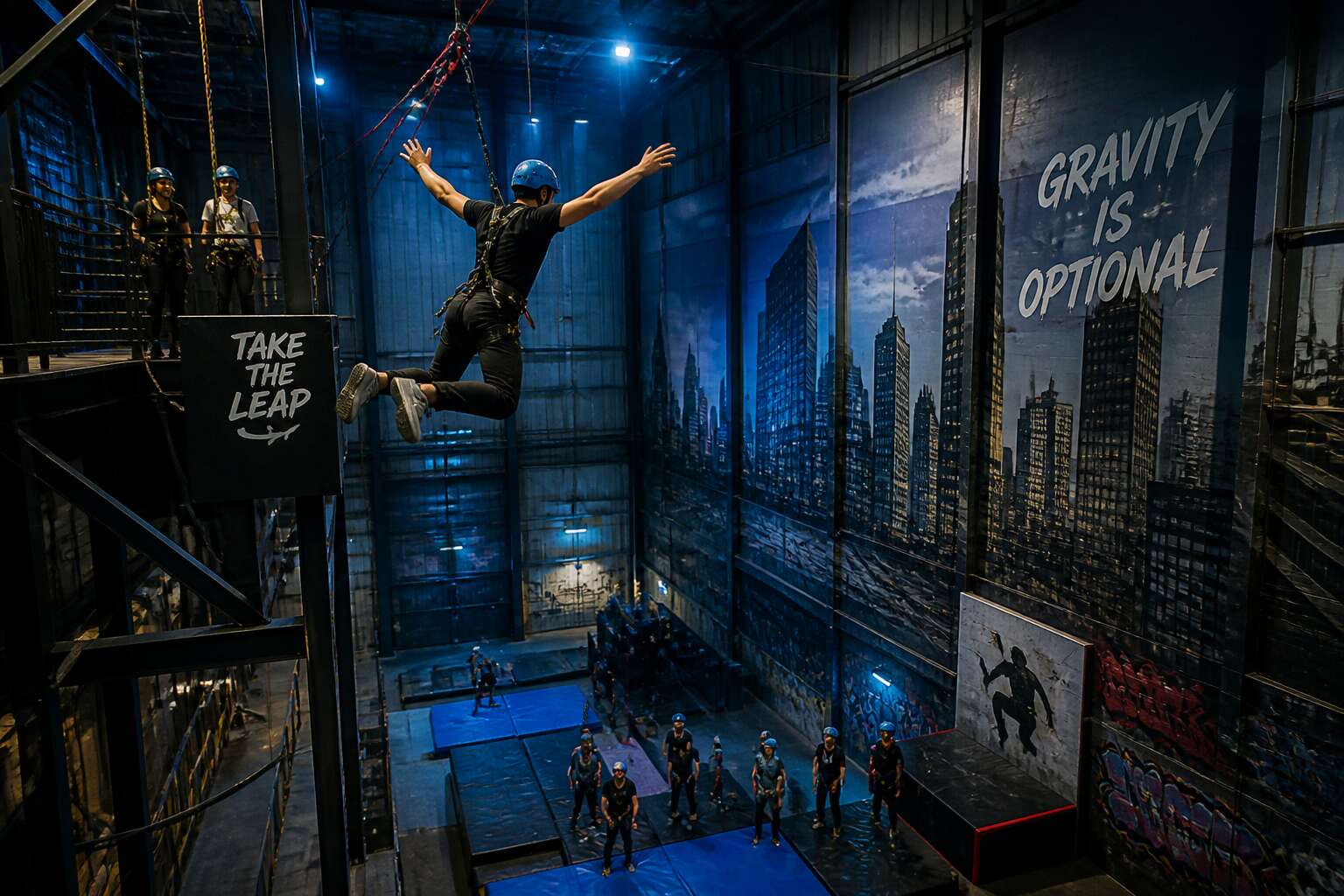
The Growing Popularity of Indoor Bungee Jumping
Why Jumpers Are Moving Indoors
Indoor centres across the United Kingdom now report a 40 percent rise in first time jumpers over the past three winters. Blustery weather and short daylight hours once decided when adventurous souls could leap from a bridge or crane, but those limitations are fading. Bungee jumping indoor removes weather as a variable, offering a smooth, controlled descent.
Consider what draws jumpers into these converted warehouses:
- Rigorous daily inspections of ropes and harnesses
- Comfortable waiting areas with viewing platforms for friends
- Year round availability without seasonal closures
The appeal also lies in repetition. Outdoor jumps demand travel and patience; indoor venues permit several jumps in one afternoon. Novices can build confidence gradually, while veterans polish their technique. Bungee jumping indoor has become a reliable alternative for those who want the thrill without the uncertainty of the elements.
Weather-Proof Adrenaline Rush
The warehouse ceiling disappears into shadow, a detail that first-timers rarely notice. Their eyes stay fixed on the padded platform and the harness being triple-checked by a technician. What began as a niche alternative has grown into a nationwide pastime. The draw? Uncompromising consistency.
Where outdoor jumpers face wind delays and weather cancellations, enthusiasts of bungee jumping indoor find a controlled environment that delivers the same free-fall sensation every single time. The landing is soft, the rebound is smooth, and the adrenaline hit is genuine.
Regulars often describe the experience as meditative. The focused descent creates a moment of total clarity that is difficult to replicate elsewhere. It also offers distinct advantages for training:
– Consistent practice for technique refinement
– No travel time to remote bridges or gorges
– Accessibility for individuals with varying fitness levels
The growing appeal is straightforward. Bungee jumping indoor strips away the unpredictability while preserving the thrill. For a nation familiar with unreliable skies, that certainty is the ultimate luxury.
Indoor Bungee as a Family-Friendly Activity
Family bookings for bungee jumping indoor rose by a third in the UK last year, according to recent industry data. Parents now treat it as a regular weekend option rather than a one-off novelty. Centres run group sessions where jumpers take turns on the rig, and the padded landing area removes the fear that stops many first-timers from trying.
- Children can start from age seven, with a minimum weight of 25 kilograms.
- Grandparents often join in using a gentler harness setting.
- Staff adjust cord length for each person, offering a shallow bounce or a deeper fall.
A typical session lasts about an hour, which fits neatly into a family day out. Bungee jumping indoor gives younger jumpers a sense of achievement and gives parents a clear view from the platform. The result is a pastime that spans three generations without demanding special fitness or athletic ability.
How Indoor Bungee Jumping Works
The Mechanics of an Indoor Bungee System
The controlled fall begins with a deliberate decision. You step off a steel platform; the cord, a bundle of latex strands, takes your weight! Unlike outdoor rigs, pulleys and a secondary safety line manage the bounce.
The mechanics are precise:
- Anchor point calculated for your weight.
- Cord tension controls rebound height.
- Braking slows oscillation before landing.
This setup keeps the jump within a confined space. The bungee jumping indoor experience relies on these calibrated components, turning a vertical drop into a rhythmic descent. The floor beneath you is padded, but you rarely touch it.
Understanding Fall Arcs and Safety Margins
The arc of a fall indoors is not a simple drop. It is a controlled curve shaped by the cord’s stretch and the anchor’s position. Understanding this arc matters because it defines the safety margins. In a confined space, each centimetre requires calculation. The system engineers a clearance zone around the jumper’s path, accounting for weight and rebound variations. I have seen jumpers swing slightly on release, which is why the margins extend horizontally, not just vertically.
The safety margins include:
– A minimum distance from the platform edge.
– A buffer above the floor for the lowest descent point.
– Lateral clearance from walls and fixtures.
These parameters turn a fall into a predictable event. Bungee jumping indoor relies on this precision to keep the experience thrilling yet secure.
The Role of Harnesses and Ropes
Here is the next section of the article, focused on the equipment that makes the entire experience possible.
—
Stepping into the harness is the moment the experience turns from an idea into a physical reality. Unlike the complex climbing gear used outdoors, the indoor bungee jumping equipment is streamlined for rapid turnover. You are strapped into a full-body harness that distributes the force of the deceleration across your thighs and shoulders. This distribution is critical. It prevents the jarring impact that could occur if the pressure were concentrated on a single point, allowing you to focus on the sensation of flight rather than the strain of the stop.
The rope itself is the silent hero of the operation. It is a dynamic cord, engineered to stretch significantly under load. This elasticity is the primary mechanism for the gentle rebound you feel at the bottom of the jump. The system uses a complex arrangement of pulleys and anchor points above the jump chamber, allowing the cord to be adjusted for different weights and desired jump intensities.
To understand the safety protocol, consider the sequence of a typical jump:
1. Weight Assessment: Your weight is logged to calculate the correct rope tension and fall distance.
2. Harness Fitting: The staff tightens the leg and chest loops to ensure a snug, secure fit.
3. The Climb: You ascend to the platform, connected to a safety line that is separate from the bungee cord itself.
This redundancy is a core principle of the design. The primary cord is responsible for the bounce, but the secondary safety line acts as a fail-safe, guaranteeing you remain suspended even in a rare equipment malfunction. When you step off the platform, the cord takes over, stretching to absorb your kinetic energy before gently pulling you back upward. The controlled stretch and rebound are what make bungee jumping indoor a thrilling yet reliably safe pursuit.
Controlled Descent and Bounce Technology
The human instinct to step into the void is old, but the machinery that makes it safe indoors is remarkably modern. When you step off the platform, the descent is not a free fall; it is a tension-based braking event. The dynamic cord catches your energy, stretches to absorb it, then reverses the load to produce the rebound. This is the controlled descent that defines bungee jumping indoor.
The secret lies in the cord’s elasticity. As you plummet, the cord’s fibers elongate, converting kinetic energy into potential energy. At the deepest point of the drop, that energy releases, and you are thrown back toward the ceiling. The cycle repeats with diminishing force until you hang still.
– The initial fall stretches the cord to its maximum load.
– The rebound lifts you back to roughly half the original height.
– The oscillation settles with each subsequent bounce, allowing for a gentle retrieval.
Operators adjust this system by altering cord length and tension for your weight. The result is a bounce that feels thrilling but never uncontrolled. Every jump follows the same physics, yet each one feels unique because of the subtle variables. That precision is the core of the technology, and it is why the experience feels safer than the raw optics suggest.
Indoor Versus Outdoor Bungee Experiences
Comparing the Thrill Factor
The thrill of bungee jumping indoor versus outdoor is a matter of sensory focus. Outside, the horizon rushes toward you, the wind roars, and the scale of the drop competes with the sensation of falling. Indoors, the environment is stripped back, so the body feels every millisecond of the free fall with stark clarity.
That shift in perception changes the entire experience. The proximity of walls and ceiling amplifies the sensation of speed, while controlled lighting keeps your attention fixed on the void below. The key differences are straightforward:
- Outdoor jumps rely on height for drama
- Bungee jumping indoor relies on compression and rebound speed
The compression of space creates a denser experience, one that feels faster even when the velocity is identical. I have watched first-timers emerge from both platforms, and the indoor jump consistently draws the sharper gasp. For many, that is the more potent thrill!
Environmental Impact and Accessibility
Yet the choice between indoor and outdoor extends beyond sensation. Most jumpers travel over an hour to a rural bridge. That journey burns fuel and adds traffic. In contrast, a bungee jumping indoor centre sits in a city centre, reachable by public transport. The environmental saving is immediate!
The indoor venue recycles its tower and harnesses for thousands of jumps a year, whereas an outdoor platform requires constant maintenance against the elements. No access roads disturb the ground, and no scaffolding interrupts the skyline. For city dwellers, bungee jumping indoor is a ten-minute walk from the office, not a day trip. This compactness removes a major barrier:
- Indoor centres offer flexible booking hours, with weather never cancelling a session.
- Specialist equipment can be adapted for wheelchairs or reduced mobility, something a high bridge rarely allows.
- City locations mean participants can arrive on foot or by bicycle.
In this way, the indoor experience turns a rare expedition into a regular, sustainable event.
Safety Records and Training Protocols
The safety ledger speaks in cold numbers. Outdoor operations face variables no protocol can tame: gusting winds, temperature shifts, degraded anchor points hidden by weather. A bungee jumping indoor facility, by contrast, operates in a sealed environment where every component is inspected under controlled light. The tower bolts, the cord tension, the harness buckles. All measured, logged, and verified.
Training differs too. Outdoor staff often rely on field experience, improvising around nature’s moods. Indoor instructors follow a stricter script. Each jumper receives the same calibration, the same checks, the same descent curve. There is no surprise weather front, no corroded bracket.
– Falls are shorter, reducing kinetic strain on the body
– Staff-to-jumper ratios stay constant throughout the day
– Emergency drills repeat in a fixed layout, not a shifting landscape
Repetition breeds reliability. Outdoors, thrill arrives with uncertainty. With bungee jumping indoor, the uncertainty is engineered away, leaving only the fall itself.
Cost Considerations for Venues and Jumpers
Indoor versus outdoor bungee experiences diverge most sharply when the ledger moves to costs. For venues, the initial outlay for a bungee jumping indoor operation is heavier. Steel towers, shock-absorbing floors, and climate systems demand capital that outdoor operators never have to raise. Yet the monthly arithmetic tells a different story. Outdoor sites bleed revenue to cancelled days; a wet Saturday empties the booking ledger. Indoor operations run every scheduled session, turning fixed costs into predictable returns.
For jumpers, the comparison is equally revealing. Outdoor jumps often appear cheaper per ticket, but add the unseen expenses: fuel, parking, a second trip when the weather breaks. A bungee jumping indoor ticket includes something outdoor pricing cannot guarantee. That is the certainty of the jump itself.
Types of Indoor Bungee Jumping Venues
Dedicated Adventure Parks
Dedicated adventure parks have transformed the indoor bungee landscape. These venues construct entire facilities around vertical challenges, from soaring ceilings to precision engineered anchor systems. You will find a more immersive atmosphere than at a generic leisure centre.
Within such parks, bungee jumping indoor frequently occupies its own hall. Consider the typical features:
- Purpose built safety flooring
- Multiple launch platforms at varied heights
- Real time monitoring stations
These elements give jumpers the chance to attempt several jumps in a single visit. Staff here specialise solely in high intensity activities, sharpening their attention to every pre jump check and post jump assessment.
Multi-Activity Trampoline Arenas
Let’s be honest, walking into a massive trampoline arena feels like entering a padded, high-octane sweet shop. The air smells of rubber and determination. These venues are the chameleons of the leisure world, hosting everything from toddler birthday parties to competitive dodgeball leagues. The side rooms often feature a dedicated corner for vertical adventure, offering a stark contrast to the horizontal flailing happening on the main floor.
Here, bungee jumping indoor is an add-on, not the main attraction. You queue alongside people clutching slushies, which creates a distinct vibe. The equipment is typically bolted onto a reinforced frame that rises through the foam pit, allowing you to launch, flip, and hover above the colourful blocks below.
There is a practical reason for this setup. The constant turnover of general visitors means sessions are timed to the minute. Your jump feels less like a private theatrical performance and more like a rapid, safe pit stop.
The jump itself is often less intense than at a dedicated facility, but the surrounding chaos can make it feel more disorienting. You are bouncing vertically while others are crashing around you horizontally. The psychological effect is peculiar. The cheers from the crowd are generic, applied to your somersault just as easily as they were to the child who landed headfirst in a ball pit.
From a logistical standpoint, the venue operator maximizes every square metre of real estate. Here are the specific considerations for the jumper:
1. Expect a strict rotation schedule that does not allow for spontaneous double jumps.
2. The launch height is typically fixed, lacking the variable platforms of a dedicated hall.
3. Grip socks are mandatory, even for the bungee harness, to ensure hygiene across all zones.
Ultimately, it is a different crowd and a different energy. The safety standards remain identical, but the atmosphere is kinetic. It is a great gateway for those who are curious about bungee jumping indoor but are intimidated by the stark, industrial feel of a specialist hangar. You get the thrill, but you get it with the smell of popcorn nearby.
Shopping Mall Attractions
Walking past the food court, you see the unmistakable harness rigs hanging above a padded pit. Shopping mall attractions offer a peculiar form of bungee jumping indoor, one that rarely extends beyond the commercial atrium. The operator typically erects a compact frame between two floors, allowing jumpers to spring upward while shoppers pause with their carrier bags. I find the experience less about height and more about spectacle.
The queue moves quickly, as the equipment is designed for throughput rather than extended play. You clip in, bounce twice, and descend. It is a transactional thrill, yet the surroundings alter your perception. For a first timer, this setting provides a softer introduction to bungee jumping indoor.
– The landing area is usually smaller than a dedicated facility’s
– The harness is adjusted on a podium visible to the public
– Sessions are often limited to two minutes
What remains is the odd sensation of bouncing toward a glass balustrade filled with curious eyes.
Mobile Indoor Bungee Rigs for Events
A concrete floor in a rented hall is the last place you expect bungee jumping indoor. Yet mobile rigs used at corporate functions tell a different story. These portable frames assemble within hours inside exhibition centres or warehouses. They bring controlled bounce technology to spaces without reinforced ceilings.
The key difference lies in the engineering. A mobile indoor bungee system uses a counterweighted base rather than ceiling anchors. It can stand on any level floor. For event organisers, that changes everything.
- Setup time is under four hours
- Weight limits range from 30kg to 120kg
- Operators recalibrate the fall arc for each location
I have watched these rigs transform a bare conference hall. The thrill remains intact, but the venue is temporary. That flexibility explains why mobile bungee jumping indoor works well for touring events across the UK.
Safety First: Preparing for an Indoor Jump
Pre-Jump Health Screening
The anticipation before a jump is electric, but a responsible venue ensures that thrill is built on a foundation of safety. Before you take the leap, a thorough pre-jump health screening is essential. This process is more than a formality; it is a critical check that protects both you and the operation.
Your fitness level directly impacts the experience. Venues typically require you to complete a health questionnaire covering recent injuries, heart conditions, and pregnancy. You will also be weighed to confirm you are within the equipment’s operational limits. This precaution is vital for the calibrated bungee cords to function correctly.
For those considering this adventure, there are a few physical requirements to keep in mind:
– You must be over the age of 18, or have parental consent if younger.
– You should be free from back and neck problems.
– Your blood pressure should be within a normal range to avoid stress on the body.
A short briefing always follows the paperwork. Listen carefully to the instructions regarding your jump technique and body position. While the staff will handle all technical rigging, your cooperation is paramount. Ultimately, adhering to these checks ensures that your session of bungee jumping indoor remains a controlled and exhilarating experience, rather than a risky one.
Equipment Inspection and Maintenance Standards
A bungee cord holds a ledger of every fall it has absorbed. In serious venues, bungee jumping indoor depends on that ledger. Cords are colour coded by installation date and retired by jump count, not by how they look. The weave might appear immaculate while the internal core has already begun to fail.
The daily inspection is tactile. Staff run gloved hands along every inch of the webbing, hunting for spraing and soft spots. Metal hardware needs the same attention:
- Karabiner gates are checked for smooth action and hairline fractures.
- Anchor bolts are examined for torque shift.
- Load cells are cross referenced against the control panel readings.
Independent auditors then test elasticity and inspect structural welds on a rolling cycle. The margin for error in bungee jumping indoor is essentially zero, and I would not step off a platform that treats these standards as optional!
Professional Instructor Training and Spotting
Every bungee jumping indoor launch rests on the human factor as much as the hardware. A qualified instructor reads the jumper’s posture, checks the harness tension, and verifies the anchorage point before each start.
Spotting demands total attention. The spotter stands beside the landing zone, hands ready, watching for cord twists and irregular rebound movement. Any anomaly triggers an immediate stop.
Training components include:
- Rigging and anchoring procedures
- Harness fitting for all body types
- Emergency descent and rescue techniques
- Communication signals between platform and floor
Instructors then complete supervised jumps under an assessor before working solo. Refresher courses run every quarter. I have seen spotter drills where a small hesitation caused a rough landing, and the session stopped on the spot!
What to Wear and What to Avoid
That moment of hesitation at the platform edge. The world narrows to a single point of focus. For many, the anticipation proves more daunting than the fall itself, which is precisely why the controlled environment of bungee jumping indoor has become a favourite starting point. It strips away the weather variables and the intimidating height of a crane, leaving just you and the physics of the bounce.
Before you even step into the harness, preparation is key. This isn’t just about adrenaline; it’s about ensuring the experience remains thrilling for the right reasons. A quick checklist helps cement the essentials.
– Wear form-fitting clothing, like a compression top and flexible trousers, to prevent chafing from the harness.
– Secure all personal items. Empty your pockets completely; rings, necklaces, and phones have no place on the jump deck.
– Tie long hair back securely and remove any glasses or sunglasses.
– Choose flat, lace-up shoes that won’t slip off during the rebound phase.
What you leave behind matters just as much. Baggy hoodies and loose jeans can bunch up uncomfortably under the rigging, and while the space is climate-controlled, overly bulky layers can restrict your movement. The staff will perform several dynamic checks on the cables and bungee cords before you are attached, a process that takes time and patience. You will feel the tug of the safety lines as they test the load, a physical confirmation that the gear is ready.
It’s normal to feel a flutter of nerves as they clip you in. The riggers will give you a final instruction set, focusing on keeping your arms crossed and your head up. Listen carefully, because that posture is what prevents the harness from riding up. When you do take that leap, the initial freefall lasts less than a second before the cord catches. The subsequent rebound is where you’ll learn to trust the equipment. Ultimately, a successful session is less about courage and more about following the precise, pre-planned procedures that make the controlled chaos feel effortless.
Rules for Children and Novice Jumpers
Approximately 80% of novice jumpers report that the briefing, not the drop, is the most cognitively demanding part. This is because the rules are absolute. For children and first timers, the procedure is non-negotiable, and it hinges on specific physical and behavioural parameters rather than a generic sense of bravery.
The age threshold is usually a strict eight years old, with a minimum weight of thirty kilograms. Below that, skeletal development is not sufficient to handle the rebound forces of bungee jumping indoor. The physiological contract is simple:
– Parents must complete a medical questionnaire detailing any history of seizures or respiratory distress.
– A jumper is restricted to a single jump if they are under the age of fourteen.
– The harness must be fitted with a crotch strap, regardless of the child’s size.
– The floor crew must be notified of any recent concussion or dizziness.
The tandem harnesses used for the very young are a different apparatus. These involve a rigid spreader bar that prevents the child’s legs from scissoring upon the first bounce. For the novice adult, the primary rule is the absence of mirrors and spectators within the immediate bounce zone. The psychological weight of an audience alters spatial awareness, leading to a stiffened posture that can cause whiplash on the second rebound. The instructors enforce a tuck and roll technique that relies on muscle memory, not thought. This removes the fear of the unknown, replacing it with a single repetitive action. The focus is always on physical compliance, never on the emotional state of the jumper.
What to Expect on Your First Indoor Jump
Check-In and Orientation Process
Expect a structured experience from the moment you arrive. Indoor bungee jumping requires a brief check-in process before you get anywhere near the platform. You will complete a waiver and provide identification. Staff will then verify your weight, as this determines the tension settings for the cord.
After the paperwork, you will move to the gear fitting area. This is not a casual process. You will be strapped into a full-body harness. A trained technician will check every buckle and clip in front of you. They will explain the connection points, so you understand how the system attaches to the overhead rigging.
The safety briefing follows the gear check. A jump master will walk you through the specific rules for this facility. You will learn the correct exit posture, how to position your arms, and what to do if you feel nervous on the platform. This briefing covers the entire sequence, from walking onto the deck to the moment you jump.
You will then watch a short demonstration. This is your chance to observe the actual jump mechanics before you commit. The staff will point out the landing zone and explain how the descent slows. The process moves at a steady pace, but you are never rushed through the final steps.
Once you are on the platform, the jump master will take over completely. They attach your line and give you a final countdown. The physical sensations are immediate and disorienting for a few seconds, but the harness catches you cleanly. After the bounce settles, the staff lower you gently to the floor. You will then be directed to a designated area to unclip and remove your gear. The entire check-in and orientation typically takes thirty minutes, which is separate from your actual jump time.
The Gear-Up Experience
The first time you feel the harness tighten around your thighs and shoulders, you realise that bungee jumping indoor is as much a mental preparation as a physical one. The gear-up experience removes lingering doubt about safety because every strap and buckle demands your attention.
A technician adjusts the leg loops with precise tension. You feel the weight of the carabiners clipped to your chest. The full-body harness provides firm, enclosing support that will hold you when the floor disappears.
– The chest strap sits high, close to your sternum.
– The leg loops press firmly against your upper thighs.
– The connection point rests between your shoulder blades.
Each element serves a purpose. You learn to trust the system before you ever step onto the platform.
Learning Basic Bounce Techniques
Your first indoor jump starts with a ridiculous thought: you paid for this. The platform is solid, the harness is snug, and then you step into space. Bungee jumping indoor removes the weather and the cliff, leaving only the drop and the rebound.
The descent lasts about two seconds. Your instinct says scream. Your legs say freeze. The rope catches, you fold forward, and the bounce returns you upward. To make the second and third bounces less chaotic, master these basics:
- Land with knees soft, not locked.
- Tuck your chin to avoid whiplash.
- Reach toward the floor as you fall, which steadies your rotation.
That sequence works. The first bounce is a mistake. The second is practice. The third is skill. Then you realise you are bouncing for the enjoyment of it.
The Jump Sequence and Common Mistakes
More than 90% of first-time jumpers report hesitation at the edge, even with a harness rated for five times their body weight. That pause is normal. It is also the moment your brain rewires itself.
Your session begins with a fifteen-minute orientation. A certified instructor checks your rig, explains the tether mechanics, and reviews hand signals. You stand on the platform, feel the slight sway of the structure, and hear an audio cue counting down from three. The descent is shorter than you expect, roughly two seconds, followed by a rebound that stretches the cord to its full elasticity.
Common mistakes are predictable. Looking down before the jump, bending your knees too early, and grabbing the rope overhead all disrupt your arc. Trust the equipment, keep your gaze level with the horizon, and let your body go limp during the first oscillation.
Capturing the Moment: Video and Photo Packages
Your first indoor jump is a sensory oddity. You expect wind, but the arena is still. You expect open sky, but you see ceiling tiles and safety netting. The descent takes two seconds, yet your memory may compress it into a single frame. Most jumpers describe a strange calm after the rebound, not adrenaline. That is the part worth keeping.
Photographers position at three points: platform level, ground level, and mid-bounce. The standard package includes:
- Forty edited stills delivered within the hour
- A 4K replay with slow motion on the first rebound
- A headcam mount that records your facial expression
Buy the bungee jumping indoor package before your jump, not after. The price is lower and the camera crew coordinates with your orientation. Without the footage, the two seconds remain a blur. With it, you finally understand what your body did.
Health, Fitness, and Psychological Benefits of Indoor Bungee Jumping
Cardiovascular and Muscle Engagement
Your heart pounds harder in four minutes on a vertical bungee rig than in twenty minutes on a treadmill. That is the payoff of ballistic resistance. bungee jumping indoor forces your body to stabilize against unpredictable forces, recruiting fast twitch fibres in your core, legs, and back.
The cardiovascular response is immediate! VO2 max climbs as you fight the elastic pull on every descent. Blood flow increases to working muscles, and aerobic capacity improves with regular sessions. For psychological benefits, the controlled risk triggers a dopamine release, sharpening focus and reducing anxiety.
- Strengthens the quadriceps and hamstrings
- Activates stabilizer muscles around the spine
- Raises resting metabolic rate for hours
Do not underestimate the mental load. Coordination and timing demand constant attention, which reduces mental noise. That is why bungee jumping indoor works as a full body workout and an emotional reset.
The Vertical Workout Advantage
The vertical workout advantage extends beyond effort. Bungee jumping indoor challenges your proprioception, a sense of joint position, in ways a treadmill cannot. Each descent requires micro adjustments from your ankles, hips, spine,and shoulders. This builds coordination and spatial awareness that transfer to daily movements.
Psychologically, unpredictability of the elastic rebound demands focused attention. A session can calm an anxious mind because you respond to the present moment. Reports of reduced irritability after a jump suggest cortisol levels dip as you regain control of your body.
- Improves dynamic balance and reactive strength
- Increases joint mobility without impact on joints
Bungee jumping indoor also raises metabolic rate for hours afterward, which helps weight management without repetitive strain. For many, this is the workout that builds steadiness across both body and mind.
Overcoming Fear and Boosting Confidence
After the first controlled descent, a jumper’s resting heart rate drops lower than pre-jump levels within ten minutes. This physiological shift corresponds to a psychological one. bungee jumping indoor teaches you that perceived danger can be managed. The body learns to respond calmly to a stressful trigger, and that lesson persists beyond the session.
Regular jumpers report a distinct shift in daily confidence. The mechanism is straightforward. You face a real risk, you act anyway, and you land safely. That sequence changes your expectations.
Here are the most common changes mentioned by participants:
- Less rumination before high pressure meetings
- Quicker recovery from sudden surprises
- Stronger sense of control during tense conversations
The effect comes from the physical act, not from positive thinking. When you jump again, the fear lessens while the competence grows. That is why bungee jumping indoor offers a durable confidence boost no amount of self talk replicates.
Stress Relief and Endorphin Release
A single jump can reduce cortisol by nearly a quarter within the first hour. The body reads the fall as danger, then discovers it is safe. That sequence releases endorphins in a sharp, sustained wave. Participants often feel a warm, clear-headed calm after the harness slows. I have watched first timers walk off the mat with slower breathing and softer shoulders.
Stress relief appears in physical signs:
- Reduced tension across the neck and jaw
- Steadier breathing patterns for the rest of the day
- A lingering sense of muscular release
The endorphin effect from bungee jumping indoor lasts well beyond the platform. The session interrupts the body’s stress loop without requiring a long recovery period. That makes it a practical reset for busy schedules.
0 Comments